In these uncertain times, with Covid-19 causing so much misery we need something to distract our thoughts and to soothe our anxieties. I have written before how the garden can do just that and if you can share this space with your family, pets and the wildlife so much the better. I am confident we are all looking out for our nearest and dearest, we will all have vulnerable others and neighbours who are grateful for our support or words of kindness. Our gratitude for the key workers and in the UK for the National Health Service staff knows no bounds. In these moments we all need to pull together and do what we can.
I had imagined I might use this little parable to highlight the need to reduce our plastic usage in the garden, to keep space aside for wildlife or to just manage with due care our little patch of the planet. But it seems so much more apt given the immediate challenges facing us.
The tiny, purposeful hummingbird can be seen all around the forests of the northern Pacific Rim. Its industry was noted by First Nation people who passed on this story.
"A fire had begun in the forest and was in danger of raging out of control. Terrified, many of the animals fled before it took over. But the hummingbird flew to the nearest water, collected a droplet and flew back to the fire dropping the water onto it. As she flew back and forth to protect her habitat, first the bear, and then the owl, the snake and cougar each called out: 'Bird, what are you doing?' The hummingbird answered them all in the same way: 'I am doing what I can'."
Please stay safe.
Friday, 27 March 2020

Sisyphus Revisited
Sometimes gardening can be a test of resolve. Over the past few weeks the local wildlife has been particularly active. The deer population have taken a delight in chomping the spring bulbs, most particularly decimating the tulips, while the badgers have taken to digging up the flower beds for me (and trashing the perennials therein!)
Filling in the holes in the lawn, and giving it the first cut with raised blades felt a little futile. Repairing the beds is sad but has to be done but there is no salvation for the tulips!
However, by way of compensation for these sysyphean tasks we have had some rather nice spring weather this week, a blessing given that we are in national lock-down.
In the meantime I hope you all stay safe and well in these most difficult of times, wherever in the world you might be.
 |
| Badger Damage |
 |
| Deer Chomped Tulips |
Filling in the holes in the lawn, and giving it the first cut with raised blades felt a little futile. Repairing the beds is sad but has to be done but there is no salvation for the tulips!
However, by way of compensation for these sysyphean tasks we have had some rather nice spring weather this week, a blessing given that we are in national lock-down.
 |
| View Across to the Farm |
 |
| Hecate iInsepecting the Spring Plants |
Thursday, 27 February 2020
The Resilience of Nature
 |
| Rain battered container |
 |
| Baptism of fire for the new tree |
 |
| Hardy little Tete a Tete |
..... so why are Hecate and Mili hiding indoors?
What good is the warmth of summer, without the cold of winter to give it sweetness?
- John Steinbeck, American writer (1902 - 1968)
Friday, 14 February 2020
Tibetan Cherry
The best time to plant a new tree is in the winter-spring window of opportunity when a bare rooted specimen is dormant, available to buy and most straightforward to plant (not being laden with foliage). Perhaps my favourite tree is the Weeping Copper beech, the Giant Redwood or the Tibetan Cherry. A Copper Beech has been long established at the front of the house by the drive, a Giant Redwood is not terribly practical, so the Tibetan Cherry was the obvious choice for an addition to the Pennine garden.
 Consequently, a fine specimen was ordered from Ashridge Nurseries. It was delivered yesterday, in immaculate packaging and condition. This nursery sells trees not based on their height (so no leaders have been artificially left to grow) but by girth of the trunk. Although the tree could be safely left for up to 10 days before planting, I took the opportunity to get the cherry into the ground while we had a break in the weather between the Atlantic storms.
Planting a tree is not complicated but there are selected top tips
~ do not plant too deeply, try to keep to the depth that the plant had been previously grown up to
~ but do make the planting hole sufficiently wide, never have roots curled around the edge of the hole
~ do not use lots of improved soil matter or compost, otherwise the tree roots will not search for nutrients beyond the confines of its planting hole
~ do ensure the trunk sits on a slightly mounded piece of earth to ensure after a good watering (with rain and not tap water) the tree does not sink down into a sump of poor drainage
~ do stake low down the trunk, at 45 degrees and braced against the prevailing wind, and remember to tie the tree to the stake and not the stake to the tree


The Tibetan Cherry or prunus serrula, is a small to medium-sized, so hopefully will sit well in our garden. It is mainly conspicuous because of its very decorative mahogany-coloured bark, which also leads to it being called Mahogany Barked Cherry. Because of its peeling bark it is also called Paperbark Cherry. It blooms in spring with small, white flowers and turns colour beautifully in autumn. It can be grown as a multi-stemmed but to remain in keeping with the cherry trees at the top back of the garden ,I intend to keep this one as a short stemmed tree with a wide crown. It will reach 8m possibly a little more in due course.
 Consequently, a fine specimen was ordered from Ashridge Nurseries. It was delivered yesterday, in immaculate packaging and condition. This nursery sells trees not based on their height (so no leaders have been artificially left to grow) but by girth of the trunk. Although the tree could be safely left for up to 10 days before planting, I took the opportunity to get the cherry into the ground while we had a break in the weather between the Atlantic storms.
Planting a tree is not complicated but there are selected top tips
~ do not plant too deeply, try to keep to the depth that the plant had been previously grown up to
~ but do make the planting hole sufficiently wide, never have roots curled around the edge of the hole
~ do not use lots of improved soil matter or compost, otherwise the tree roots will not search for nutrients beyond the confines of its planting hole
~ do ensure the trunk sits on a slightly mounded piece of earth to ensure after a good watering (with rain and not tap water) the tree does not sink down into a sump of poor drainage
~ do stake low down the trunk, at 45 degrees and braced against the prevailing wind, and remember to tie the tree to the stake and not the stake to the tree

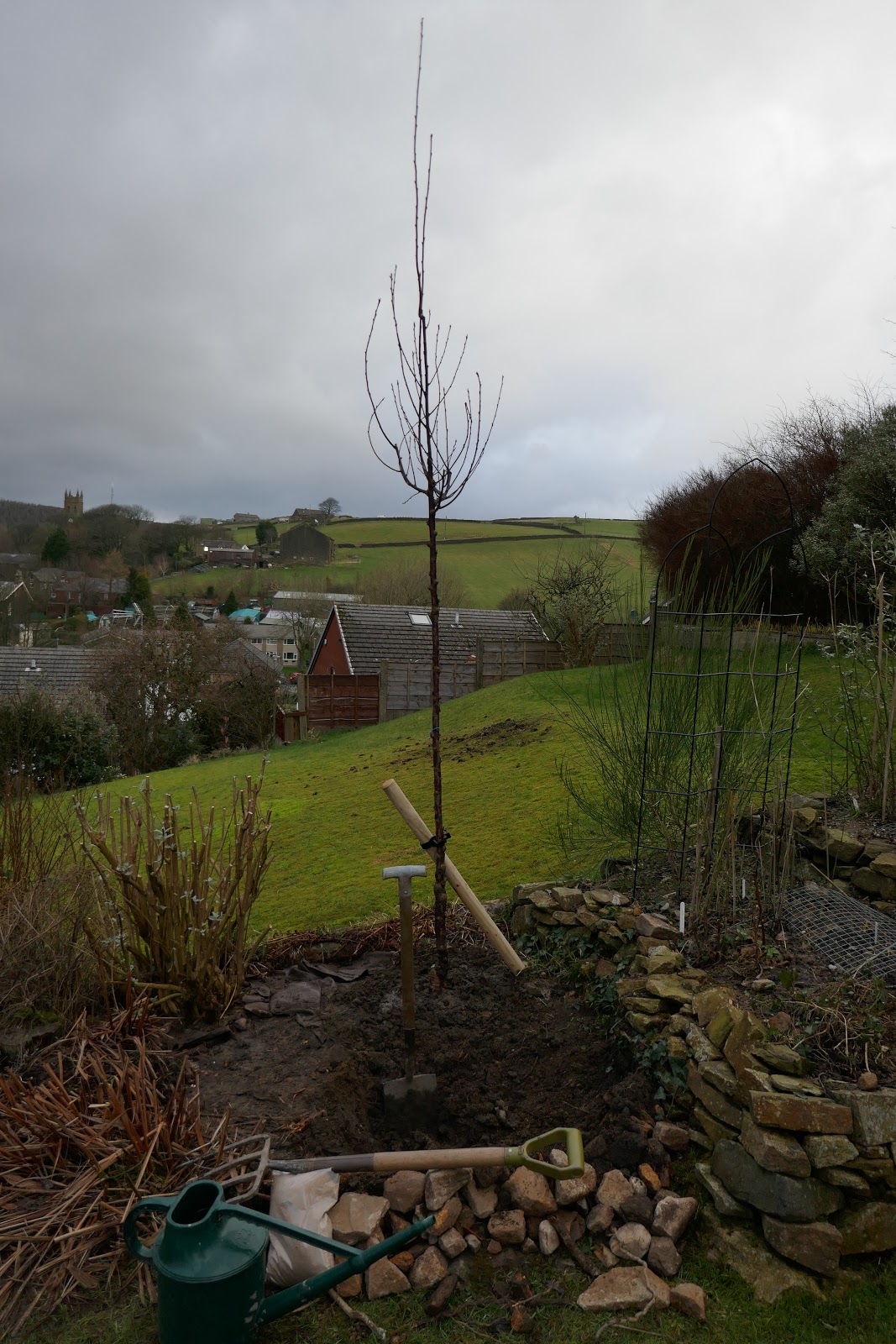

Finally, but certainly not least in the Pennine garden, think about what protection might be needed.
Most gardeners will get away with a proprietary spiral tree guard, or similar. But because of the constant threat of hungry deer, I enlisted the help of a good friend, who happens to be a gardener with an eye for practical design and engineering skills to match. He also has some pretty handy DIY gear too! So the young sapling now has what I hope will be an effective protection, fingers crossed!
 |
| The Tibetan Cherry |
The Tibetan Cherry or prunus serrula, is a small to medium-sized, so hopefully will sit well in our garden. It is mainly conspicuous because of its very decorative mahogany-coloured bark, which also leads to it being called Mahogany Barked Cherry. Because of its peeling bark it is also called Paperbark Cherry. It blooms in spring with small, white flowers and turns colour beautifully in autumn. It can be grown as a multi-stemmed but to remain in keeping with the cherry trees at the top back of the garden ,I intend to keep this one as a short stemmed tree with a wide crown. It will reach 8m possibly a little more in due course.
One day it might look like this specimen we viewed at RHS Harlow Carr.
Wednesday, 5 February 2020
Glow in the Dark Snowdrops
While I am well aware how regularly snowdrops have feature on these pages before I cannot resit adding another note about their charms. especially after dark. The brilliance of their white petals can illuminate the garden at night. Sadly, we do not really get a good view from indoors but the fact the mossy bank were the snow drops appear is by the front door means that we do see them regularly. The porch light comes on when entering the house and this positively makes the snowdrops glow in the dark.

I would imagine virtually any garden would benefit from a small or large drift of "naturalized" snowdrops, particularly if they can be seen both during the day and after dark. They are also minimal effort to maintain once established. So they are a top tip for the labour saving gardener.

Monday, 3 February 2020
Melancholic Charms
 |
| View Looking Towards St Johns |
 |
| Snowdrops |
 |
| Winter Aconites |
Sadly there is always the need to patrol for winter damage. The wind has blown down several fence panels and the badgers are still digging up the lawns. Top tip: keep on top of the maintenance work while you can, the busy spring months will soon be upon us. This might not be a labour saving tip but it is a sensible way to spread the efforts across the calendar year. So as tempting as it might be to find some indoor jobs, wrap up and get outside.
 |
| Badger Scrapings |
Tuesday, 14 January 2020
Mid Winter Colour
 |
| A distracted Mili |
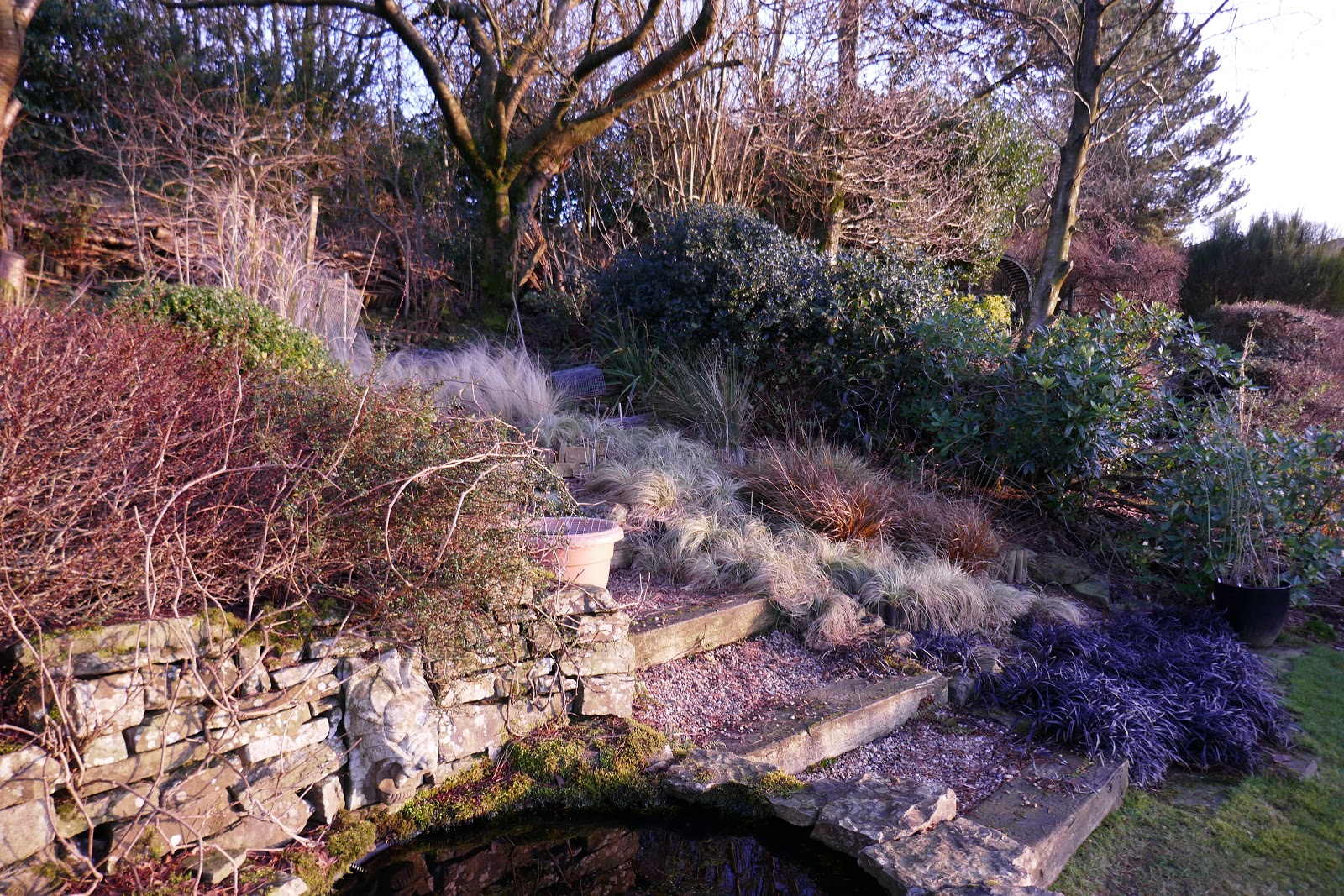
It is the winter months when the colours of the grasses are much appreciated and I can recommend the use of the sedges as, although not true grasses, as they do hold their own mixed among "real" grasses like the pony tail. They also seem to be best in large clumps or drifts when the contrasts are most evident.
Top tip: for winter interest do not ignore the modest grasses and sedges. While the merits of the ophiopogon planiscapus 'Nigrescens' have been mentioned in previous posts, the red hook sedge and frosted curls make for a nice contrast.

 |
| The conservatory is the rainy day refuge |
Subscribe to:
Posts (Atom)