Showing posts with label Patio. Show all posts

Thursday, 30 June 2022

A New Patio

The garden has seen a major change over the past 2 months, namely, the patio has been pulled apart and rebuilt. The time had come to finally do away with the old pressed concrete that was poured over 30 years ago. It has served us well but we both had a desire to get rid of the tired looking patio. The new design was not a difficult choice, it had to fit with the style of the rest of the garden, so a rustic "naturalistic" feel was essential. It was also a critical choice as this is the part of the garden, being immediately outside the back door, that is the most well used.

The choice of local Yorkstone paving was made to match the sun terrace and other drystone walling elsewhere in the garden. The source was the exact, same local quarry, so a beautiful coloured stone was guaranteed. It was never really an option to go for Indian sandstone or something else with a lot of transportation involved, the ethos of minimizing our carbon footprint has become more important to us both. The use of clinically precise porcelain tiles might have been the fashionable and contemporary choice but this would have been the anti thesis of the ambiance we have tried to encourage. The riven finish was also selected to complete the look.

Sadly, the living wall has had to be cut back. However, the builders have done an excellent job in minimizing the damage. It helped that one of the team was a keen gardener himself. All the plants have been saved and the vegetation is set to grow back again, hopefully for a complete rejuvenation.


The old wall has been dismantled and it is easy to see how much of the garden is simply solid rock, with a very shallow layer of soil.
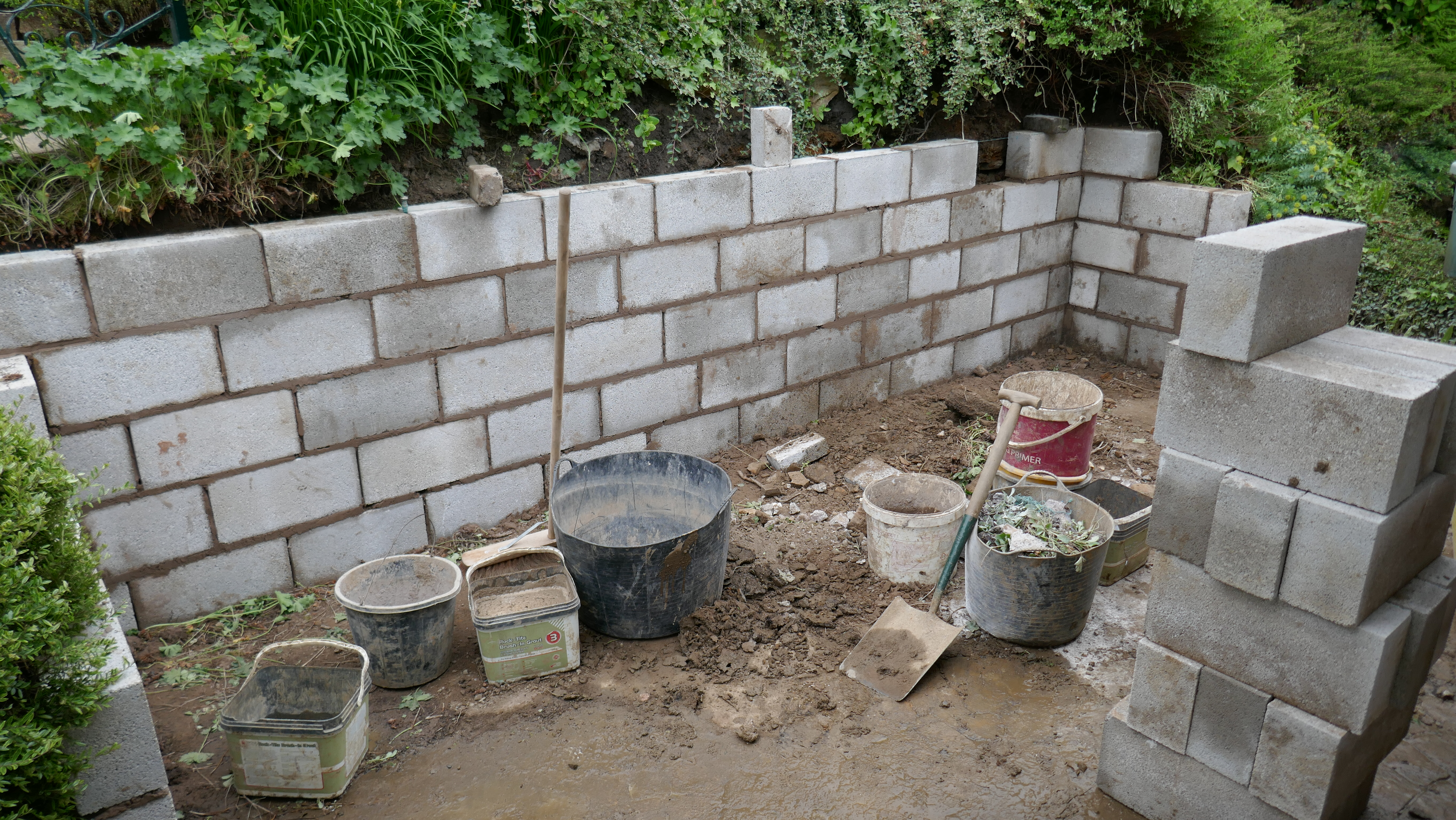

Solid concrete blocks are laid for integral strength in the new retaining wall.


Newly quarried, riven faced Yorkstone paving is laid with precision.


The builders have finished and now the start of my contribution, the first pass of the rendering.


Rendering finished, perhaps not perfect, but with luck the living wall will grow back and cover the majority of the retaining wall in 18 months time (and disguise my best efforts). At least, that is the plan, as the Mediterranean feel of the freshly rendered wall is not really in keeping with the vibe of the rest the garden. But the rendered finished had the critical advantage of preserving as much of the newly created extra space as is possible. Updates will follow.

Meanwhile it is now time to get back to the rest of the garden, which has had to take a back seat for weeks now. Blogging can also be resumed again!

Tuesday, 6 October 2020

Pots for Winter Interest

In a recent post I revisited the idea of putting together our bulb lasagnes. In a similar vein my better half decided that it would be a nice idea to have some winter interest, in the form of two winter pots. Placed on the patio near to the kitchen door she has composed two linked displays that should look just right all the way through to next spring.


The pots are packed with evergreens, they have plants with different shapes and form and only one specimen is duplicated, the red hook sedge. But the red hook sedge and the fact the pots themselves are matched serves to unify the two displays into a coherent and interesting splash of colour.

Top tip: when planning little displays such as these winter pots consider how you might be able to use the plants afterwards. For instance, if you use a dwarf conifer (as shown in the pot on the left) think about where it will be relocated to when the tub is emptied out in spring. I have a little space in the heather beds earmarked for this fine specimen.

Alternatively,

Top tip: to keep the costs of winter tubs down you might consider utilizing plants that you already have in the garden, not surprisingly, the grasses where taken from seedlings that had just self seeded and the red cyclamens is a survivor from previous years.


Friday, 29 March 2019

Spring into Action

We are now nearly a third of the way through Spring. It has not disappointed, with some glorious days on the Pennines and, of course, some dreek and dank ones too. The gardens and gardeners have now sprung into action and there is a noticeable burst of activity. I always feel removing the covers from the garden furniture marks a critical day in the garden calendar and the onset of a series of jobs.

The picture shows the difference when the covers have been removed and the jet wash has blasted away the winter grime. No wonder it puts a spring in the step.

Before
After, during the inspection


It is revealing how much difference  a patio spring clean can make. The small tub in the centre has been a particular success, with the stark white of the fritilaria uva vulpis, a definite for repeating next year.


Other important jobs have included mulching, raking the lawn and some shifting of plants from conservatory to cold frame. This in turn creates more indoor space for yet more seeds and repotting of seedlings. In other words it is all go!

The same is true of the plant kingdom and the joy of seeing the new buds and the start of regrowth is simply a delight.


Monday, 7 January 2019

A Backbone of Evergreens

At this time of the year it can seem bare, damp and somewhat lifeless in the garden. Of course we all know this is part of the natural cycle, as many perennials are deep into their dormancy and the annuals have finally given up the ghost. The skeletal appearance of most of the hardwoods is stark and bleak, particularly when viewed against the grey winter sky. But paradoxically the same bare trees are undeniably beautiful in silhouette with their fragile looking veins and occasional watery sunshine bleeding through the branches.

However, it is the evergreens which are the backbone of the winter garden. On the Pennines we are fortunate in that a wide variety of evergreens will do well. Holly, laurel, yew, ivy, heathers not to mention a host of domestic and non native tree species, mostly the conifers, will all flourish.

The bare stems of the cherry tree would be a quite uncompromising backdrop to the top of the garden were it not for the evergreen shrubs below. Even the rhododendron is still providing some relief of green, albeit not my favourite garden plant. 

The ornamental grasses (and sedges in our case) remain good value, no matter what the season and can distract the eye from a lawn that is again looking moth eaten as the badgers have started grubbing up selected spots.


All areas of the garden need an evergreen framework, as the pictures show, that both the patio and the terrace each retain some greenery and a little interest deep into winter. The wildlife also appreciate the cover as do the two cats cats in our Pennine garden.

Top tip: When planning your garden think of the evergreens as the backbone of your design. Even though we might not spend as much time outside in the middle of January as we will in the height of summer all outdoor spaces will be the better for a splash of a little greenery.

Monday, 2 July 2018

More Reflections

I just could not resist sharing another lovely reflection. This time it is in the lower pond, by the patio and is the first water lily of the year to open out. The tumbling water can be seen in the background but it is worth remembering that water lilies do not really like disturbed water conditions. As you can see the lily in this pond is far enough away from the stream of falling water and the reflection would not be as clear if the water was rippled.

However, for those people who have larger ponds with filtration systems it is apparently perfectly fine for the lilies to have moving water so long as it is not "disturbed" with excessive surface motion or splashing.

Wednesday, 6 June 2018

Vertical Garden

 The patio area is looking particularly lovely at this time of the year. The main attraction for me is not the pots and baskets but the vertical garden on the retaining wall. There is a current trend for this type of planting, the idea being to make ugly walls into attractive or productive garden spaces and at the same time to make the very best use of space. particularly where it is at a premium.

It is possible to buy hanging baskets and planters from any garden centre. Connected drop down fabric pockets are also increasingly popular. DIY enthusiasts can use reclaimed pallets for vertical planting schemes but we have been lucky and are able to plant directly into the gaps in the retaining wall. It really is surprising how many plants can cope with quite small amounts of soil in the most difficult sites. Some plants like the ferns will just find a home by themselves others have to be helped along. I would strongly encourage any gardener to try out a variety of plants and flowers, certainly do not restrict yourselves to alpines, which are the traditional standby for vertiginous locations with thin soil.

The patio area is sheltered but does not always get the best of the sunshine. However, it is where you can find my plant of the month, "Gran's lillies". These tough little flowers have grown towards the top of the wall for decades. Planted by our Gran in the early 1980's they come up every year without fail and the only attention they need is to have the dead foliage cut down to ground level every October.

Their beauty lies in their unfussy simplicity and of course the sentimental value they have for us both.


Tuesday, 20 February 2018

Design for Winter

Although much of the design of our garden is ad hoc evolution I have been quite conscious for the past few years about gradually redesigning of some of the rooms. It is a little luxury that retired gardeners can afford. The black and white terrace, for instance, is one of the few areas clearly visible from the house. As it was constructed less 18 months ago it is still quite some way off maturity. But I have been quite conscious about the need for some winter interest and structure in this part of the garden, exactly because it is visible from the kitchen. In the morning, when it is light, the planting of the terrace and the evergreen nature of the patio living wall are a welcome splash of colour, all be it mostly green.


The heathers, the hebe (midnight sun), the mouse eared chick weed, the sarcococca humilis, the viburnum, the black grasses and taller black phormium, all give the area a certain interest on a grey February morning. Even the buddleia in the bed above adds some structure, it has been deliberately left largely unpruned. The "butterfly bush" still has some leaf and greenery visible but it will need to be cut back down in the next week or so as the flowers are always on this years new growth.

The first signs of spring will also be evident by looking out of the window onto this space. The spring bulbs are just beginning to show in the raised beds and pots.

This is in direct contrast to other beds in the garden which still look somewhat bleak and rather bare at this time of the year. But they will also need a little attention, weeding and mulching. Fortunately, I can avoid stepping all over the beds (and avoid compacting the heavy soil) by carefully finding a foothold on the retaining stonework.

TIP: avoid standing on the soil in the beds wherever possible and if not use a piece of board laid on the ground to spread your weight.


Wednesday, 26 July 2017

Water Lilies


Both lower and upper ponds now have what in my opinion is the most attractive of aquatics, the water lily. They are not difficult to grow but can be tricky to get to flower. I am not entirely sure why some years are better than others and I will resolve to study the best ways of looking after the lilies a lot more in future.


The fact that we get any flowers on the lower pond is quite contrary to much accepted wisdom. The pond is hardly in full sun, the water is not totally calm and the plants have not been fertilized in years. I also suspect that the depth of water is a little shallow for the type that we have. But the buds keep appearing and the majority open into lovely blooms.

It is hardly surprising that the water lily is often regarded as a symbol of optimism, as it is renowned for returning to the waterways even after difficult periods of drought. It is certainly a characteristic that it needs in the Pennine garden.


Monday, 17 July 2017

Evolution

Left is how the lower pond looked in 1990, pretty much after it was first completed. It is being explored by Gheera, the previous feline with first dibs on this particular garden (more about her in future posts). As mentioned in the previous blog entry the re-modelling work is never really complete. The desire to change the pond shape, the surface area the fall of water is never completely sated. It really is better to build as big as you can first time, although it is so much fun to change and "mess around" later! The photograph reminded me of the number of marginals that we used to have....... perhaps they will make a comeback?
The view to the right is the pond this year. As you might be able to detect, it is subtly wider, virtually double the size. The fall of water is also different (from a different angle you would see it is now in two steps) which means it is less noisy, and therefore less like a running bath tap. One of the best things about any water feature is the relaxing sound you can get it to make in the background.The surrounding planting is also now much more mature and the ugly conifer has long since been removed.

It will, of course, sooner or later need altering again. Certainly, as the head gardener becomes less agile, tending the vegetation on the banking becomes more of a challenge. But I have a few more years yet!


Monday, 19 June 2017

Form and Texture

We have been enjoying the summer weather this week. The other day while just having a light salad lunch on the patio I happened to notice a quite delightful sight. I suppose on many other occasions I have simply failed to spot the intriguing natural beauty of the reflected light playing on the pond-side foliage. The tumbling water was just catching the early afternoon sunlight to create an almost psychedelic strobe light effect on the leaves of the ferns. It is a reminder to not overlook or take for granted the little magical elemnts that are present in even the smallest of gardens.

The vegetation surrounding the lower pond has been planted for its form and texture. The fronds of the different ferns, the contrasting shapes of the creeping plants are intermingled in a naturalistic way. On the other bank the feather like astilbes and a few aquilegia all grow well in this shaded woodland like part of the garden.


Thursday, 1 June 2017

Two Living Walls

The cotoneaster is now totally covered in thousands of bees, what a marvellous plant. It is hard to imagine that the bee population is in severe decline when you witness a spectacle like this, but it is no doubt true. So we must all do our best.

The other living wall is that by the patio. Now the summer is about to arrive this modest space is really enhanced by the vertical planting. In particular at this time of year"Gran's lilies" come into bloom. Planted by (you guessed it) gran over 30 years ago they always give the modest splendid albeit brief display. They cling to the upper most part of the wall and despite having only a small depth of soil they seem to thrive on this challenging spot. The yellow is a an eye catching shade and the form of the flower quite exquisite. Thanks gran for the decades of pleasure.


Meanwhile Mili finds a new spot to doze! This definitely does not do her street wise image any favours.


Thursday, 30 March 2017

Bulb Lasagne

A bulb lasgne is an easy way to guarantee some early season colour. A job to do in October, simply pop down to your local garden centre buy your favourite bulb selections and garden. I  like to use two black planters that happen to be supported on legs. This is useful for drainage and protection from slugs.

Starting from the base of a couple of old bits of broken crockery add a layer of compost. Then bed in a good selection of your favourite tulips bulbs. More compost and some nice daffodils can be added to make another layer. More compost, then I add a personal plant favourite, dome dwarf iris bulbs. Finally, another compost layer and then some winter pansies for the top. Hey Presto.


Although my winter pansies never seem to last much more than a couple of weeks before beginning to look increasingly disheveled, at least they offer the bulbs some protection from hungry squirrels. My other tubs need a protective layer of chicken wire draped across the top. Do any readers have any good tips for prolonging the just planted look of my pansies? I suspect the rather gloomy November light down on the patio had something to do with it.


Patio furniture still under cover and a Mili taking shelter in a secret hideout

The Patio

The patio is the most accessible part of the garden. Directly outside the kitchen door, this is the most sheltered spot that we have. Although the pressed concrete floor is now looking a little weathered, that is hardly surprising, given that it was laid over 25 years ago. The patio is bounded by a living wall, covered in ivy and creeping jenny and has a small pond at one end. It is perhaps the best used part of our outdoors. The usual table and chairs allow for a civilized summer breakfast or alfresco lunch. By contrast the bench by the pond is a tranquil shady retreat in the mid afternoon summer heat. The patio is also directly accessed via the flap by Mili and Hecate.

Through winter it is  visible from the kitchen window and at the moment spring colour in the pots and tubs heralds the real start of the gardening year.  A real treat, which happens to be nice and easy to do are the bulb lasagnes in the tubs. Given the blog's stated purpose I will share my tips in a later post.