Friday, 26 October 2018

Vigilance and Protection

 The garden is now beginning to look a little end of season. The weather is certainly fraying the edges. However, this does not deter the keen gardener or the two cats from venturing forth. Mili and Hecate have new challenges to tackle, there is a new cat on the block and the deer are being much braver venturing into the garden for the berries. There is little doubt that they feel more up for these potential confrontations when one or other of their humans is about for (moral?) support.

Vigilance is key
Facing up to the competition

Cosmos still in flower
 I have been busy putting in bulbs and readying pots for spring. The tender plants and some of the half hardys will now need to be brought inside, or housed in the cold frame. The conservatory will be fumigated this weekend, cleaned up thoroughly and readied for plants to be brought inside. A little thought and preparation now will pay big dividends for next spring.
Top tip: Do not delay too long before protecting your prize specimens. Remember they will be expensive to replace. For the cat kingdom and the gardener this is the season for vigilance and protection

Sunday, 14 October 2018

Ayrshire and Culzean

 If you should ever decide to holiday in Scotland I cannot recommend highly enough the joy of visiting Ayrshire in the autumn. I have lost count of the number of times we have visited at this time of the year or at least a few weeks later when we were more restricted by school half terms. Without fail on each occasion we have spent a day visiting Culzean Castle and gardens.


This glorious 260 hectare estate was once the playground of David Kennedy, 10th Earl of Cassillis – a man who was keen to impress with his wealth and status. Opulent to the extreme, the park is planted with conifers and beech, sculpted around miles of sandy coastline dotted with caves, and finished off with a swan pond and formal gardens and fruit-filled glasshouses (currently under refurbishment).

 The castle is splendid and the Adam staircase simply quite spectacular. The views out to sea and across the gardens are stunning while the collections are detailed and fascinating. However, most gardeners are naturally drawn outside into the gardens. They, of course, benefit from the warming westerly winds that blow across the waters of the firth. These in turn have been warmed by the North Atlantic Drift, the sea current which originates in the tropical latitudes around the Caribbean (a pity we do not feel any such benefit on the Pennines).

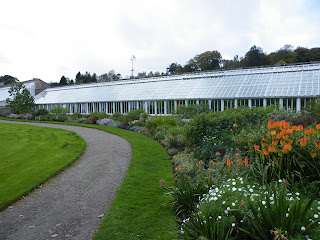
The gardens are largely formal in style, designed to create vistas viewed from the house or terraces. Some of the tree species are now of an age where their majesty provides the perfect framework. I particularly enjoyed the very large walled gardens, which are divided into two spaces, one which will be devoted more to providing produce, the other for relaxation, cut flowers and specimen plant types. The mild Ayrshire climate combined with the warming micro climate of the sheltering walls provide the opportunity for growing a plethora of exotics. The huge vinery along the Western side of the walled gardens was once able to produce enough wine for the estate, for locals and for nearby hotels and inns!
Hopefully, this will be fully restored again on our next visit.

Red Hues of Autumn


The autumnal palette of colours is a seasonal treat not to be overlooked. Before our short break away (see next post) the garden was awash with red. Whilst this display was mostly berries, it was also leaves, such as those on the Virginia Creeper by the upper pond. The birds and other wildlife will certainly benefit but hopefully not before we have had a little time to savour the seasonal ambiance.

The rowan in our garden and in many of the neighbouring plots is perhaps the most eye catching of them all. The clusters of bright red berries make a colourful autumn splash. High in vitamin C the berries can (apparently) be made into a jelly which goes well with game meats, though on their own the berries do not taste pleasant. In the past it was not uncommon in Wales for an alcoholic liquor called "diodgriafel" to be brewed from the berries; the process, according to an 18th. century traveller to the region involving: '...pouring water over them (berries), and setting the infusion to ferment. When kept for some times, this is by no means an unpleasant liquor...'

However, I shall be leaving our berries for the birds!

Wednesday, 26 September 2018

Past the Equinox

 The equinox has now passed and we are truly well into autumn. This is a time of the year I always enjoy. The sun is noticeably lower in the sky and the light it casts even well into mid morning is more evocative. This week I have been able to see my breath when out early in the garden and sadly the first frosts will not be too far behind. At this stage it is all hands to the deck protecting the half hardy and even more tender plants.

However, there are still jobs to be done. Hedges at the back are all trimmed, borders need tidying (deadheading is still important) and now the lawn will require some serious attention. Sadly, this is not a job I can get overly enthused about as my success rate with the lawn is pretty dismal! But I will continue to give it my best and for the time being resist the temptation to grub up even more grass for a new border or bed.

It is also rather nice that long, ice cold beverages are now giving way to the warming mugs of coffee. Gardening is a relaxing pastime but you must remember to make time for the occasional rest break. Top Tip: build time into the "to do job list for the day" to just sit down and chill, but wait, if you can, for that 15 minute hiatus when the sun comes out. The coffee will taste that much better with a bit of warmth on your back!

Wednesday, 12 September 2018

My Gardening Philosophy (or reasons why I do not like gardening all the time, part 1)

Horrid little aphids have taken a shine to my achillea. Fortunately they do not seem to be causing too much harm but I must be very cautious because the long term damage is yet to be seen. Of course, I have treated the plants (along with the rest of the garden specimens) with neem oil/ soap drench. The aphid colonies are certainly diminished in size (my best guess is by about 80%) but a second treatment in about 7 days time is certainly called for. Environmental factors can be so frustrating!

Hedge Trimming

Today the autumnal weather has been a little kinder and the shears have been out to trim back the berberis and the laurel which frame the upper seating area. This is a good time for hedge work as the birds have nested and the growth is now slowing.

As you can see the rowan is in berry and the plants in the dazzle beds to the left of the photo are still doing their best. This year was my first time for cosmos, they came as a free packet of seeds with an edition of the Gardeners World magazine. I had not really appreciated what a marvellous little plant they are; colourful, easy to grow, not too fussy about situation and very long lasting. I will definitely find a place for these little beauties in years to come. If you know a plant that is more versatile and might do equally well in a Pennine garden then please let me know.
Top tip: give cosmos a go!

This time of the year when blooms are in ever shorter supply the value of foliage become that much more apparent. The monochrome beds by the terrace are still holding their own. The mouse eared chick weed does a very good job of adding the lighter/ whiter leaf colour, and the flax, hebe and ophiopogon 'Nigrescens' give the contrast. Of course, a little sunshine does help, make the most of it while we can.

Thursday, 6 September 2018

My Gardening Philosophy (reasons I enjoy gardening part 4)

Grey squirrels are seen regularly 
You might think, given the previous post, that I would consider wildlife to be more of a problem than a benefit. But this could not be further from the truth, it is the joy of being outside close to nature and all the wildlife that makes gardening such a pleasure. The geography of your garden, the habitats you provide and the wildlife havens close by your plot can bring into your space a huge variety of creatures. Every rest break gives a little opportunity to be still and listen, then to look around and hopefully to glimpse something wild, natural and heart warming. "Our task must be to free ourselves. By widening our circle of compassion to embrace all living creatures and the whole of nature and its beauty." Albert Einstein.

another visitor and predator
I am sure that some people might consider it paradoxical that you might want both cats and wildlife in the garden. It is an undeniable fact that cats will both deter and diminish the population of some species. Alarmist media reports are prone to exaggerate the levels of predation, often quoting flawed and inadequate studies, such as the Peter Churcher and John Lawton research. This is based on the prey brought home by 70 cats over the period of one year, the results of which where then erroneously extrapolated for the whole of the country. The fact that the sample was entirely rural village cats and only consisted of such a very small sample makes it seriously unrepresentative. However, the media prefer to perpetuate the myth of the natural born killer. The "prey" brought home would also include a significant proportion of scavenged creatures, many of which would certainly be the victims of plate glass windows, RTAs and other non feline causes.

It is not unfeasible that Hecate and Mili will bring back a present or two. But Hecate is far from agile and struggles to manage the steps up the garden let alone chase down a rapid moving small mammal. Mili does well for her age but she undeniably has vision which is less than 20:20 so would have a difficult time catching most creatures but the odd spider should beware.
Sparrow Hawk another predator on the front lawn